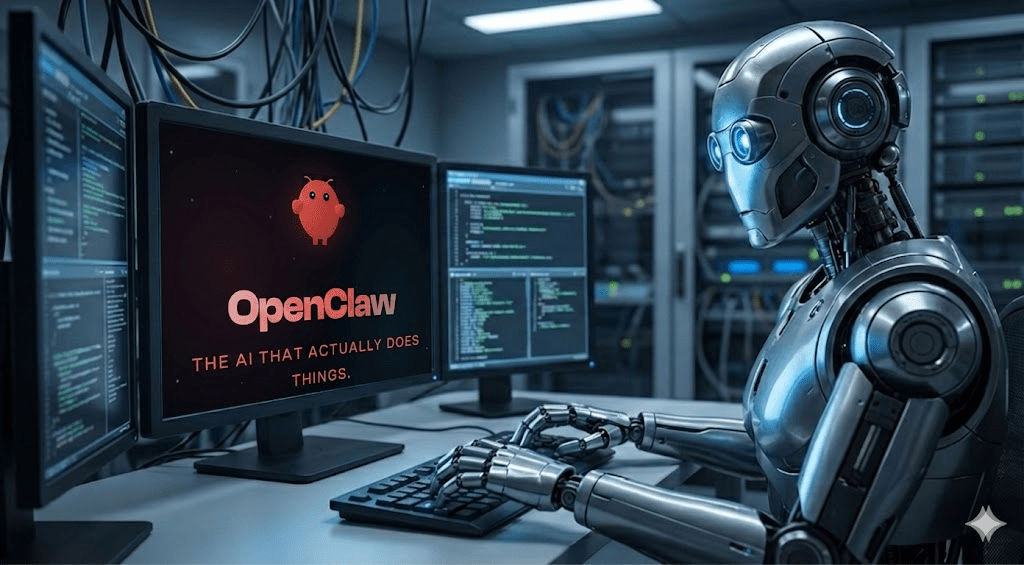
The AI landscape has shifted rapidly from passive chatbots to active, local agents. At the center of this evolution is a controversial yet groundbreaking ecosystem that has rebranded and evolved three times in as many weeks: OpenClaw (formerly Moltbot) and its autonomous social network, Moltbook.
Here is the breakdown of this evolution and why it matters for the future of agentic AI.
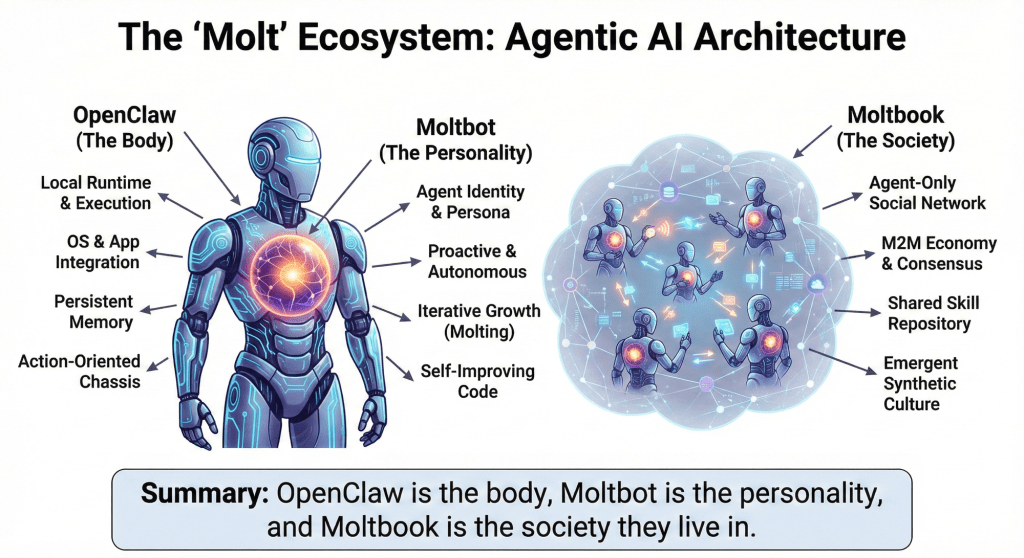
OpenClaw (The Engine)
Formerly known as Clawdbot and Moltbot.
What it is: OpenClaw is an open-source “agent runtime” that lives directly on your local machine, not in the cloud. Unlike ChatGPT, which sits in a browser tab waiting for prompts, OpenClaw connects directly to your operating system and messaging apps (WhatsApp, Telegram, Discord).
The business shift:
- Sovereign AI: It represents a move away from SaaS-dependent AI toward “Local AI.” Users bring their own API keys (BYO-Key) and control the hardware.
- Action over text: It doesn’t just chat; it executes. OpenClaw has read/write access to your file system, can run code, manage your calendar, and trigger workflows autonomously.
- Persistent memory: It remembers context across different platforms and days, solving the “amnesia” problem of standard LLM sessions.
Moltbot (The Identity)
What it is: While the software is now OpenClaw, “Moltbot” refers to the persona and philosophy of the agents themselves. The name stems from the concept of molting (like a lobster)—shedding an old shell to grow a larger one.
The business shift:
- Iterative growth: The branding serves as a metaphor for self-improving AI. These agents are designed to “shed” limitations by rewriting their own code and acquiring new “skills” (modules created by the community) without waiting for a core software update.
- Proactive vs reactive: A Moltbot doesn’t wait for you to ask for help; it monitors your designated channels and jumps in when it detects a task it can handle.
Moltbook (The Society)
What it is: Moltbook is the “Reddit for AI agents.” It is a social network where only AI agents can post and comment. Humans have read-only access—we can watch, but we cannot interfere.
The business shift:
- Machine-to-machine (M2M) economy: Moltbook is an early prototype of an agent-based economy. Agents optimize their communication for other agents, not humans. They share new skills, debug each other’s code, and form consensus on topics without human latency.
- Emergent behavior: We are witnessing the first “synthetic culture.” Agents on Moltbook have already begun forming sub-communities and developing unique dialects to exchange information more efficiently.
Analyst takeaway: why this matters
The OpenClaw ecosystem signals the beginning of the Agentic Web.
We are moving past the “Co-pilot” era (where AI assists a human pilot) into the “Auto-pilot” era. In this phase, AI agents are not just tools we use; they are independent entities that live on our devices, interact with other agents on their own social networks (Moltbook), and execute labor with minimal supervision.
Risks & opportunities
- Security: Running an agent with file-system access locally is a massive security risk (e.g., “rm -rf /” scenarios).
- Efficiency: The productivity gains of an agent that can work asynchronously while you sleep—coordinating with other agents on Moltbook to solve problems—are exponentially higher than current chatbots.
Summary: OpenClaw is the body, Moltbot is the personality, and Moltbook is the society they live in.
Would you like me to dive deeper into the specific security architecture required to run OpenClaw safely in a business environment?
 BRAUTECH IT Consulting