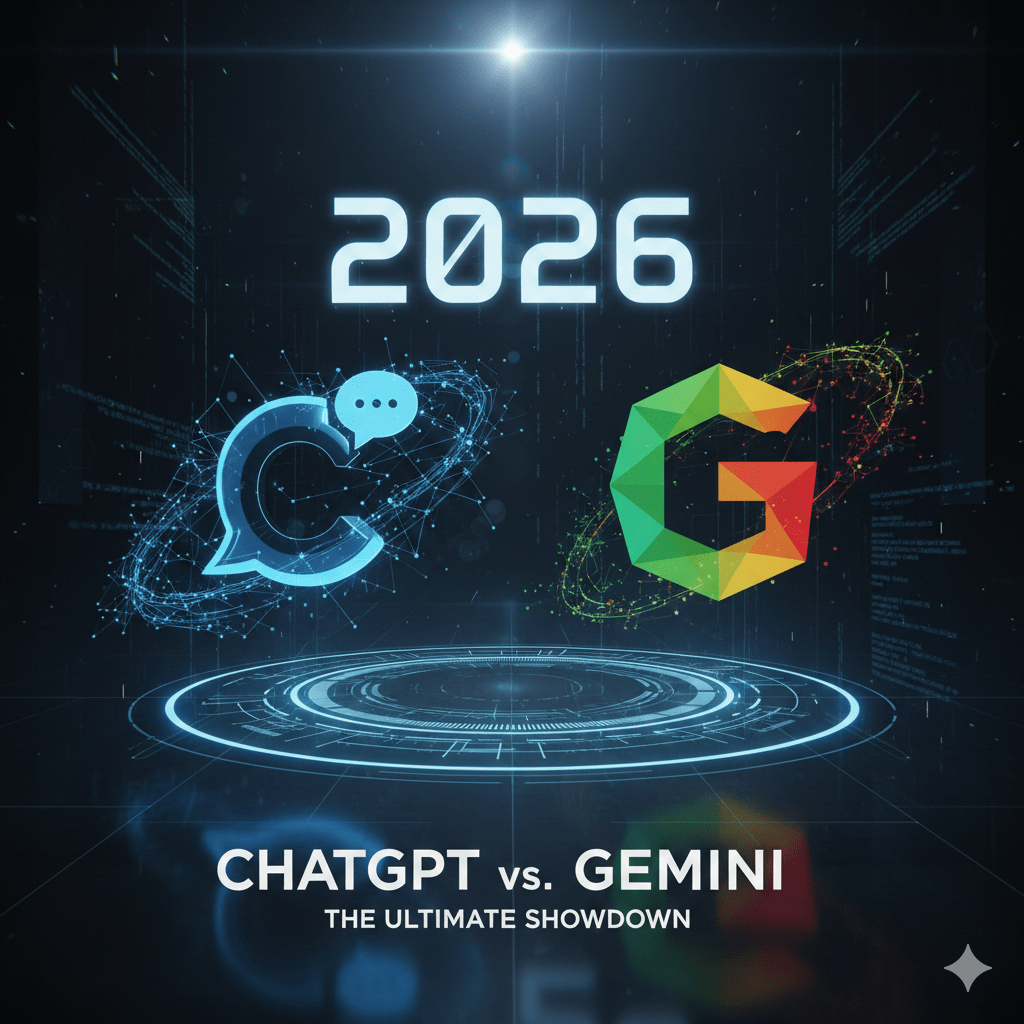
The landscape of Artificial Intelligence has shifted. We are no longer in the era of “simple chatbots”; we are in the era of “AI Workhorses.” As we navigate 2026, the two titans—OpenAI’s ChatGPT and Google’s Gemini—have carved out distinct territories.
If you are paying for a premium subscription, you shouldn’t be choosing based on brand loyalty. You should be choosing based on your workflow. Here is how these two giants stack up today.
The Gemini Advantage: The Data Powerhouse
Google Gemini has evolved into the ultimate tool for users who deal with high volumes of information and live within the Google ecosystem.
Massive Context: The “Big Picture” Tool
Gemini’s greatest superpower is its massive context window. While other models might “forget” the beginning of a long document, Gemini can ingest thousands of pages of text or hours of video in a single go. If you are a developer analyzing a massive codebase or a researcher cross-referencing ten different whitepapers, Gemini’s ability to “see” it all at once is unmatched.
The Ecosystem Integration
Gemini isn’t just a tab in your browser; it’s an extension of your digital life. Because it is natively integrated into Google Workspace, it can bridge the gap between your emails, your spreadsheets, and your calendar. It’s less of a chatbot and more of a proactive assistant that knows where your files are and what your schedule looks like.
Multi-Modal Research
Gemini excels at “Deep Research.” It is notably faster at scanning dozens of web sources simultaneously to generate comprehensive reports. Furthermore, its ability to analyze video files—not just reading a transcript, but actually “watching” the visual data—makes it the superior choice for content creators and video professionals.
The ChatGPT Advantage: The Creative Architect
While Gemini wins on data volume, ChatGPT remains the king of execution, nuance, and personalization.
Human-Centric Writing and Tone
When it comes to the “feel” of the output, ChatGPT still holds the edge. Whether you are drafting a delicate email, writing a screenplay, or brainstorming marketing copy, ChatGPT tends to produce more natural, less “robotic” prose. It captures human nuance and follows complex stylistic instructions with greater precision.
The Rise of AI Agents
The defining feature of ChatGPT in 2026 is its “Agent” capability. It has moved beyond just answering questions to actually performing tasks. ChatGPT can now navigate the web to execute actions—like booking travel or managing software workflows—making it a true partner in productivity rather than just a source of information.
Memory and Personalization
ChatGPT’s long-term memory has become its most underrated feature. It learns your brand voice, your formatting preferences, and your recurring needs over time. This reduces the “prompt engineering” burden; the more you use it, the better it understands exactly how you want your work delivered.
Summary: Which One Should You Pick?
Choosing between the two comes down to your primary “Mode of Work”:
- Choose Gemini if: You are a data-heavy professional who needs to summarize massive documents, perform rapid-fire research, or deeply integrate your AI with Google Drive and Gmail.
- Choose ChatGPT if: You are a creator or entrepreneur who needs high-quality writing, personalized assistance that remembers your style, and “agent” features that can take tasks off your plate.
The Pro Tip for 2026
Don’t be afraid to be “AI-fluid.” The most productive users in 2026 often use the free versions of both to see which model “clicks” with a specific project before committing their most complex tasks to one. The best tool isn’t the one with the most features—it’s the one that shortens the gap between your idea and the finished product.
 BRAUTECH IT Consulting